
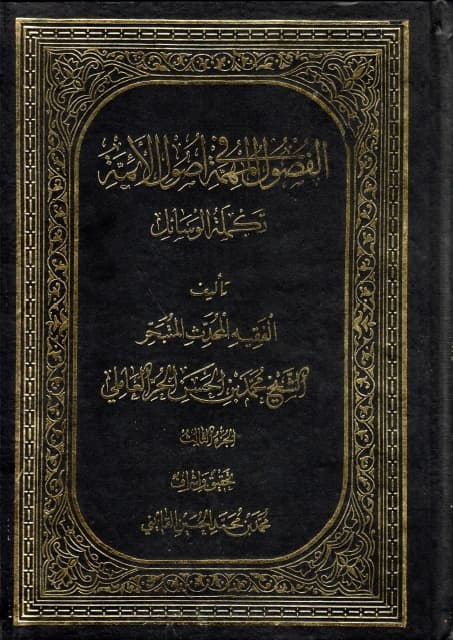
Al-Fusul al-Muhimma fi Usul al-A'imma
The Important Chapters on the Foundations of the Imams
Author: Muhammad ibn al-Hasan al-Hurr al-Amili
Select Volume
Chapters
208 total chapters
1
Chapter 1 — A Selection of Qur'anic Universals on Foundations, Branches, and More
2
Chapter 2 — God's Creation of Intellect and Those Who Perfect It
3
Chapter 3 — The Obligation of Using Rational Evidence to Establish the Authority of Textual Evidence
4
Chapter 4 — Only That Which Calls to Obedience to Allah and Following the Religion Is Considered Rational
5
Chapter 5 — General Knowledge Is Innate and Essential, and All Details Must Refer to the Book and Sunnah
6
Chapter 6 — Prohibition of Acting on Speculations, Desires, Incomplete Reasoning, and Opinions in Beliefs
7
Chapter 7 — Prohibition of Taqlid in Beliefs and Taking Them from Sources Other Than the Prophet and Imams
8
Chapter 8 — God Is Eternal and There Is Nothing Else Eternal
9
Chapter 9 — God is One with No Partner in Lordship
10
Chapter 10 — God Is Unlike Any of His Creatures in Essence or Attributes
11
Chapter 11 — Every Creature Indicates the Existence, Knowledge, and Power of Its Creator
12
Chapter 12 — All That Is Besides Allah Is Created, New, and Preceded by Non-Existence
13
Chapter 13 — God Cannot Be Perceived by Any of the Senses
14
Chapter 14 — God Is Not Composite and Has No Parts
15
Chapter 15 — The Names of Allah Are Not Allah and Worship Should Be Directed to the Named Entity
16
Chapter 16 — God is Eternal, Everlasting, Without Beginning or End
17
Chapter 17 — God Is Not Bound by Space and Does Not Reside in Any Place
18
Chapter 18 — God Cannot Be Comprehended in Essence or Attributes
19
Chapter 19 — God Cannot Be Seen by the Eye or Perceived by Vision in This World or the Hereafter
20
Chapter 20 — God Cannot Be Comprehended by Imagination
21
Chapter 21 — God Is Not Described by Quality, Location, or Direction
22
Chapter 22 — God Is Not Described by Body or Image
23
Chapter 23 — The Attributes of Allah Are Not Separate or Distinct from His Essence
24
Chapter 24 — The Essential Attributes of Allah Are Eternal and Are Identical to the Essence
25
Chapter 25 — The Attributes of Allah Are Created and Are the Same as the Action
26
Chapter 26 — God Does Not Change in Essence or Attributes and Is Not Like Anything Else
27
Chapter 27 — All Names of Allah Are Created and Distinct from Him
28
Chapter 28 — The Meanings of Allah's Names Do Not Resemble the Meanings of Creation's Names
29
Chapter 29 — God Is Not Described by Motion or Transition
30
Chapter 30 — All Knowledge Is Equal in Its Nature and All Powers Are Equal in Their Ability
31
Chapter 31 — Everything in the Kursi and the Kursi and What Is in It in the Throne
32
Chapter 32 — Allah Created Creation Without Any Pre-existing Substance
33
Chapter 33 — God Created Creation Without Any Need for Them or Purpose for Himself
34
Chapter 34 — Nothing Occurs in Existence Except by Allah's Decree, Will, Knowledge, and Permission
35
Chapter 35 — Allah Erases and Establishes What He Wills Without Changing the Eternal Knowledge
36
Chapter 36 — What Allah Informed His Prophets and Proofs Is Rarely Subject to Change
37
Chapter 37 — God Knows All That Is Known
38
Chapter 38 — The Invalidity of Tafweez in the Actions of Servants
39
Chapter 39 — The Invalidity of Compulsion in the Actions of Servants and the Establishment of a Middle Position
40
Chapter 40 — Prohibition of Idol Worship and Similar Practices and Approaching Sacrifices to Them
41
Chapter 41 — God Has No Offspring or Partner
42
Chapter 42 — God Has No Opponent or Equal
43
Chapter 43 — God Cannot Be Described by Face, Hand, or Any Limbs
44
Chapter 44 — The Importance of Discussing the Wonders of Allah's Power Over Speculation on His Essence
45
Chapter 45 — The Importance of Discussing Badā' Over Qadā' and Qadar
46
Chapter 46 — Permissibility of Speech on All Matters Except What Is Prohibited
47
Chapter 47 — Allah Is the Creator of All Things Except the Actions of Servants
48
Chapter 48 — The Invalidity of Transmigration of Souls into Bodies
49
Chapter 49 — Divine Guidance to Correct Beliefs Without Coercion
50
Chapter 50 — God Does Not Commit Injustice or Oppression
1
Chapter 1 — The Obligation of Seeking Knowledge for Every Muslim and Asking About Necessary Jurisprudential Rulings
2
Chapter 2 — The Prohibition of Taking Religious Knowledge from Anyone Other than the Prophet and the Imams and the Obligation to Refer to Them in All Rulings
3
Chapter 3 — The Obligation of Learning Their Sciences as Sufficient and Its Individual Recommendation and Necessity as Needed
4
Chapter 4 — It Is Not Permissible to Teach Falsehood Without Clarifying Its Falsehood
5
Chapter 5 — The Importance of Humility Towards Teachers and Students
6
Chapter 6 — The Virtue of Sitting with Righteous Scholars and Engaging in Conversation and Discussion
7
Chapter 7 — Every Incident Requires a Specific Juridical Ruling with Definitive Evidence from the Imams
8
Chapter 8 — It Is Not Permissible to Speak or Act on Any Legal Rulings Without Knowledge
9
Chapter 9 — Obligation to Act on Knowledge by Doing What Is Required and Avoiding What Is Prohibited
10
Chapter 10 — Obligation to Refrain and Exercise Caution in Unclear Matters and Avoid Potentially Prohibited Things
11
Chapter 11 — The Non-Obligation of Displaying Knowledge with Taqiyya and Fear, and Its Obligation Otherwise
12
Chapter 12 — The Permissibility of Narrating Hadith by Meaning
13
Chapter 13 — Obligation to Act on Their Hadiths Reported in Reliable Books and Writing Hadith
14
Chapter 14 — The Prohibition of Following Non-Infallibles in Jurisprudential Matters
15
Chapter 15 — The Prohibition of Bid'ah and Acceptance of Bid'ah and That Every Bid'ah is Haram
16
Chapter 16 — Prohibition of Acting on Personal Opinion in Legal Rulings
17
Chapter 17 — Prohibition of Using Any Type of Qiyas in Legal Rulings Including Qiyas al-Awlawiyya
18
Chapter 18 — Prohibition of Acting on Any Speculative Jurisprudential Opinions in Legal Rulings
19
Chapter 19 — It Is Not Permissible to Act on Legal Rulings Based on Weak Evidence or Speculative Reasoning
20
Chapter 20 — Obligation to Refer to Hadith Narrators for Their Reports on Rulings
21
Chapter 21 — Ways to Reconcile Between Different Hadiths
22
Chapter 22 — Only the Imam or those who convey the Imam's ruling may judge in legal matters
23
Chapter 23 — Prohibition of Disagreement in Rulings Except for Taqiyya and Only One Truth in Any Matter
24
Chapter 24 — Prohibition of Acting Outside the Qur'an and Sunnah in Legal Rulings
25
Chapter 25 — Prohibition of Acting on Consensus Not Known to Include the Infallible
26
Chapter 26 — Obligation to Act on General Texts and Rule on All Their Individual Instances Except What is Excluded by Evidence
27
Chapter 27 — Obligation to Act on Absolute Texts and Prohibition of Restricting Them Without Evidence
28
Chapter 28 — Obligation to Refer Ambiguous Hadith to Clear Ones in Cases of Conflict and Contradiction
29
Chapter 29 — Permissibility of Acting on Reports from the Public About Ali in Events Without Specific Texts
30
Chapter 30 — Prohibition of Acting According to the Public and Their Ways Even from the Hadiths of the Imams
31
Chapter 31 — The Permissibility of Delaying Clarification and Response from the Prophet and Imams
32
Chapter 32 — Obligation to Act on the Narration of the Trustworthy in Legal Rulings from the Imams
33
Chapter 33 — The Prohibition of Deriving Legal Rulings from the Apparent Meanings of the Quran Without Understanding Their Interpretation
34
Chapter 34 — Prohibition of Deriving Theoretical Rulings from the Apparent Meanings of Hadith Not from the Imams
35
Chapter 35 — The Virtue of Guiding People to the Rules of Religion and Dispelling Doubts and Misconceptions About Mu'minin
36
Chapter 36 — The Obligation to Be Cautious of Following Evil Scholars in Jurisprudential Rulings
37
Chapter 37 — Obligation to Act on Authenticated Hadiths from Them by Tawatur
38
Chapter 38 — Obligation to Act on Hadiths Confirmed by Evidence from Them
39
Chapter 39 — The Prohibition of Asserting the Falsehood of Reports Attributed to Them While Allowing Both Possibilities
40
Chapter 40 — Obligation to Act on Authentic Hadiths from Them Even if They Allow Taqiyya Without Opposition
41
Chapter 41 — Desirability of Performing Any Permissible Act for Which Reward Is Reported
42
Chapter 42 — Every Obligation That Cannot Be Fulfilled Is Excused
43
Chapter 43 — All Prohibitions That Force a Person to Act Are Permissible Except What Is Excluded
44
Chapter 44 — The Invalidity of Imposing What Is Beyond One's Capacity and That There Is No Hardship in Religion
45
Chapter 45 — Certainty Is Not Undone by Doubt, but by Certainty Itself
46
Chapter 46 — Everything in the Quran with the Word "Or" Indicates Choice and "Whoever Does Not Find" Indicates Order
47
Chapter 47 — All Types of Halal Are Permissible Until Specific Haram Is Identified
48
Chapter 48 — The Importance of Prioritizing Acts of Worship According to Divine Order
49
Chapter 49 — The Requirement of Evidence for Obligatory Actions and Exceptions to Precautionary Measures
50
Chapter 50 — The Meaning of the Verses of Permissibility and Prohibition in the Quran